
Waraba Gold Confirms In-Situ Gold Mineralisation at Fetiko Within a 1.9 Kilometre Gold-in-Saprolite Corridor, Tengrela Gold Project, Côte d'Ivoire
Original announcement by cse on
- Company
- Waraba Gold Limited
- Ticker
- WBGD
- Exchange
- CSE
- Region
- Côte d'Ivoire
- Primary commodity
- Gold
- Secondary commodities
- None reported
- Document categories
- Drill results
- Extracted
- 2026-09-24 14:07:26 UTC
Analysis by Minestarters Atlas
Atlas analysis published:
Minestarters Atlas analysis
Summary
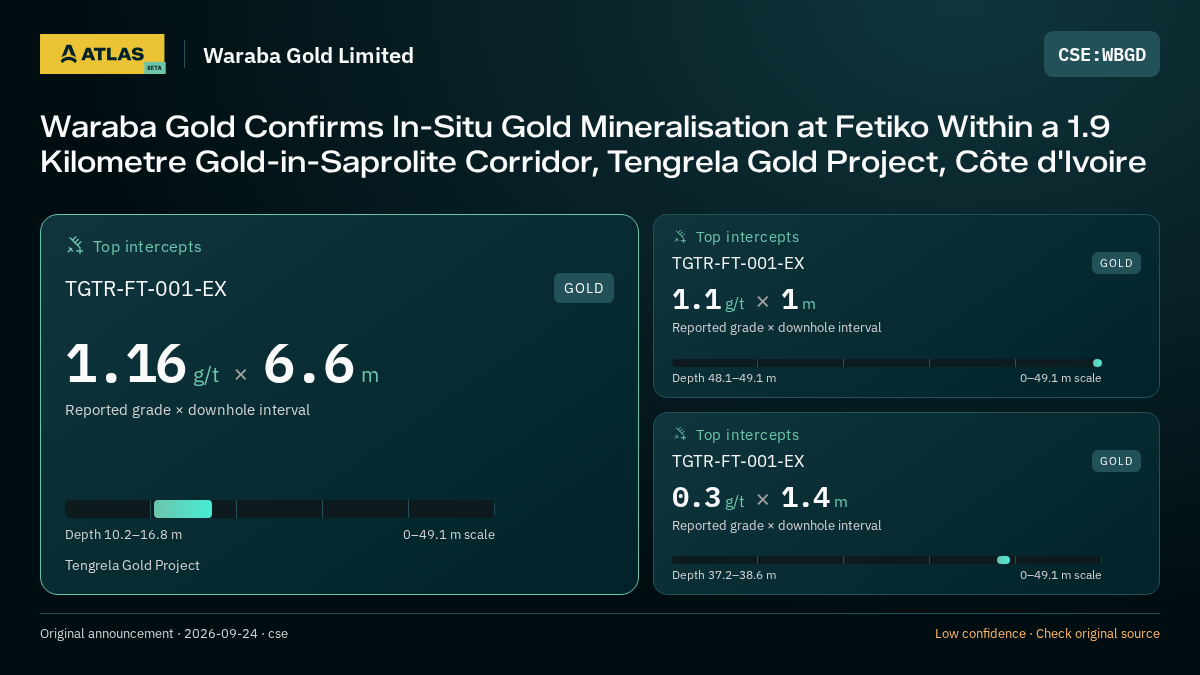
Waraba Gold Limited announced initial trench channel-sampling results from its Fetiko target on the Tengrela Gold Project in Côte d'Ivoire, confirming in-situ gold mineralization with an intercept of 6.60 metres at 1.16 g/t Au. An extensive auger geochemistry program defined a 1.9-kilometre gold-in-saprolite anomaly, with a maiden reverse circulation drill program now being designed to test the target in bedrock.
Reasoning: Initial trenching and auger results at the Fetiko target confirm significant in-situ gold mineralization and define a large gold-in-saprolite anomaly, providing strong justification for a maiden drill program and advancing the early-stage exploration project.
Positive factors
- In-situ gold mineralization confirmed by trenching
- Large 1.9 km gold-in-saprolite anomaly defined by auger program
- Maiden drill program being designed, indicating project advancement
- QA/QC procedures disclosed and reviewed by Qualified Person
- Project located in a known gold belt with nearby operating mines
Negative factors
- True widths of trench intercepts are not known
- Auger results are geochemical and not drill intercepts, requiring follow-up drilling
- High sample-to-sample variance noted for gold mineralization style
Low confidence — this extraction should be reviewed alongside the original source.
Facts used in scoring: 3
Classification and evidence
Apparent Width Onlynegative
Interval given as downhole width with no true width or drill orientation — apparent width may overstate true thickness.
Why it applies: The document explicitly states that 'True widths are not currently known and reported lengths are channel-sample lengths', indicating that the reported intercept lengths may not represent true thicknesses.
Evidence · text
“True widths are not currently known and reported lengths are channel-sample lengths.”
QA/QC Disclosedpositive
Release includes QA/QC disclosure — certified lab, QP sign-off, or stated methods (blanks, standards, duplicates).
Why it applies: The release details the insertion of certified reference materials, blanks, and field duplicates, and mentions laboratory internal control programs, all reviewed by a Qualified Person.
Evidence · text
“The Company inserted certified reference materials, blanks and field duplicates into the auger sample stream at an overall rate of approximately one control sample in every 20 routine samples... The laboratory additionally ran its own internal control programme across the same sample batches, comprising blanks, preparation blanks, in-house standards and repeat and split analyses of routine samples.”
Cut-off Disclosedpositive · Story-specific tag
Cut-off grade used for resource reporting is clearly stated, enabling like-for-like comparison.
Why it applies: The document clearly states the cut-off grade and internal dilution rules used for reporting intervals.
Evidence · text
“Intervals are reported at a 0.30 g/t Au cut-off, with a maximum of 3 metres of internal waste and a minimum length of 1 metre.”
Step-Out Extensionpositive
Mineralization extended beyond the previously known limit.
Why it applies: The auger program defined a 1.9-kilometre gold-in-saprolite anomaly, extending the known mineralization footprint.
Evidence · text
“define a coherent zone of anomalous gold in saprolite extending over approximately 1.9 kilometres along a north-north-east trend”
Nearology Playneutral
Value premise rests on proximity to a known deposit rather than own results.
Why it applies: The project's location is highlighted by its proximity to the Syama and Sissingué gold mines, suggesting value based on nearby discoveries.
Evidence · text
“situated within the Birimian-aged Boundiali greenstone belt between the Syama (Resolute Mining) and Sissingué (Perseus Mining) gold mines”
Extracted facts
Stored fact records: 3. Some facts used in scoring do not have a stored record.
Drill Results (3)
TGTR-FT-001-EXTengrela Gold Project · goldGrade: 1.16Grade Unit: g/tIntercept: 6.6 mView all detailsHide details
Identity
- Hole ID
- TGTR-FT-001-EX
- Project
- Tengrela Gold Project
- Commodity
- gold
- Region
- côte d'ivoire
- Reported Region
- Côte d'Ivoire
- Ticker
- WBGD
Geometry
- Grade
- 1.16
- Grade Unit
- g/t
- Intercept
- 6.6 m
- From
- 10.2 m
- To
- 16.8 m
Classification
- Deposit Type
- orogenic
- Program
- exploration
- Sample Type
- channel
- Mining Method
- open_pit
Location
- Location
- Fetiko target
- Easting
- 786611
- Northing
- 1150933
- CRS
- WGS84 / UTM Zone 29N
- Elevation
- 357 m
- Azimuth
- 120 °
- Loc. Confidence
- medium
- Loc. Source
- document
QA/QC
- Laboratory
- SGS Côte d'Ivoire
- QA/QC Disclosed
- Yes
- Lab Certified
- Yes
- QP Signed
- Yes
- QA/QC Methods
- blanks, standards, duplicates, check_assays
Compositing
- Cutoff Grade
- 0.3
- Cutoff Unit
- g/t Au
- Dilution Disclosed
- Yes
- Max Dilution
- 3 m
Review
- Needs Review
- No
- Interp. Status
- scored
- Historical
- No
Dates
- Event date
- 2026-09-24T00:00:00.000Z
Reasoning: This trench intercept confirms in-situ gold mineralization at the Fetiko target with a moderate grade, providing a strong basis for follow-up drilling, though true width is yet to be determined.
Positive factors
- Confirms in-situ gold mineralization in weathered bedrock
- Grade of 1.16 g/t Au is moderate for an open-pit orogenic gold target
Negative factors
- True width is not known, reported length is channel-sample length
Evidence · table
“1.16”
Context: 6.60
Tags used in scoring
QA/QC Disclosedpositive
Release includes QA/QC disclosure — certified lab, QP sign-off, or stated methods (blanks, standards, duplicates).
Why it applies: qaqc_disclosed is true
Compositing Transparentpositive
Cut-off grade and internal dilution rules are clearly stated for reported intervals.
Why it applies: cutoff_grade and internal dilution are both stated
TGTR-FT-001-EXTengrela Gold Project · goldGrade: 0.3Grade Unit: g/tIntercept: 1.4 mView all detailsHide details
Identity
- Hole ID
- TGTR-FT-001-EX
- Project
- Tengrela Gold Project
- Commodity
- gold
- Region
- côte d'ivoire
- Reported Region
- Côte d'Ivoire
- Ticker
- WBGD
Geometry
- Grade
- 0.3
- Grade Unit
- g/t
- Intercept
- 1.4 m
- From
- 37.2 m
- To
- 38.6 m
Classification
- Deposit Type
- orogenic
- Program
- exploration
- Sample Type
- channel
- Mining Method
- open_pit
Location
- Location
- Fetiko target
- Easting
- 786611
- Northing
- 1150933
- CRS
- WGS84 / UTM Zone 29N
- Elevation
- 357 m
- Azimuth
- 120 °
- Loc. Confidence
- medium
- Loc. Source
- document
QA/QC
- Laboratory
- SGS Côte d'Ivoire
- QA/QC Disclosed
- Yes
- Lab Certified
- Yes
- QP Signed
- Yes
- QA/QC Methods
- blanks, standards, duplicates, check_assays
Compositing
- Cutoff Grade
- 0.3
- Cutoff Unit
- g/t Au
- Dilution Disclosed
- Yes
- Max Dilution
- 3 m
Review
- Needs Review
- No
- Interp. Status
- scored
- Historical
- No
Dates
- Event date
- 2026-09-24T00:00:00.000Z
Reasoning: This intercept, while lower grade, suggests the presence of multiple gold-bearing structures, contributing to the overall prospectivity of the target, though true width is unknown.
Positive factors
- Indicates additional gold-bearing structure within the trench
Negative factors
- Grade is at the weak threshold for an open-pit orogenic gold target
- True width is not known, reported length is channel-sample length
Evidence · table
“0.30”
Context: 1.40
Tags used in scoring
QA/QC Disclosedpositive
Release includes QA/QC disclosure — certified lab, QP sign-off, or stated methods (blanks, standards, duplicates).
Why it applies: qaqc_disclosed is true
Compositing Transparentpositive
Cut-off grade and internal dilution rules are clearly stated for reported intervals.
Why it applies: cutoff_grade and internal dilution are both stated
TGTR-FT-001-EXTengrela Gold Project · goldGrade: 1.1Grade Unit: g/tIntercept: 1 mView all detailsHide details
Identity
- Hole ID
- TGTR-FT-001-EX
- Project
- Tengrela Gold Project
- Commodity
- gold
- Region
- côte d'ivoire
- Reported Region
- Côte d'Ivoire
- Ticker
- WBGD
Geometry
- Grade
- 1.1
- Grade Unit
- g/t
- Intercept
- 1 m
- From
- 48.1 m
- To
- 49.1 m
Classification
- Deposit Type
- orogenic
- Program
- exploration
- Sample Type
- channel
- Mining Method
- open_pit
Location
- Location
- Fetiko target
- Easting
- 786611
- Northing
- 1150933
- CRS
- WGS84 / UTM Zone 29N
- Elevation
- 357 m
- Azimuth
- 120 °
- Loc. Confidence
- medium
- Loc. Source
- document
QA/QC
- Laboratory
- SGS Côte d'Ivoire
- QA/QC Disclosed
- Yes
- Lab Certified
- Yes
- QP Signed
- Yes
- QA/QC Methods
- blanks, standards, duplicates, check_assays
Compositing
- Cutoff Grade
- 0.3
- Cutoff Unit
- g/t Au
- Dilution Disclosed
- Yes
- Max Dilution
- 3 m
Review
- Needs Review
- No
- Interp. Status
- scored
- Historical
- No
Dates
- Event date
- 2026-09-24T00:00:00.000Z
Reasoning: This moderate-grade intercept further supports the presence of multiple gold-bearing structures at Fetiko, enhancing the overall prospectivity, though true width remains unconfirmed.
Positive factors
- Indicates additional gold-bearing structure within the trench
- Grade of 1.10 g/t Au is moderate for an open-pit orogenic gold target
Negative factors
- True width is not known, reported length is channel-sample length
Evidence · table
“1.10”
Context: 1.00
Tags used in scoring
QA/QC Disclosedpositive
Release includes QA/QC disclosure — certified lab, QP sign-off, or stated methods (blanks, standards, duplicates).
Why it applies: qaqc_disclosed is true
Compositing Transparentpositive
Cut-off grade and internal dilution rules are clearly stated for reported intervals.
Why it applies: cutoff_grade and internal dilution are both stated
How Atlas produces this analysis
Minestarters Atlas uses automated extraction to summarize mining announcements, identify reported measurements, and classify supporting evidence. Sentiment reflects the extracted narrative and classification rules; it is an interpretation, not a reported measurement. Evidence quotes and context are provided where available. Missing data, low-confidence results, and review flags indicate limitations. Check the original publisher announcement before relying on an interpretation.