
One World Lithium deploys DLCE equipment to UCI, UBC labs
Original announcement by miningcom on
- Company
- One World Lithium
- Ticker
- OWLI
- Exchange
- Unavailable
- Region
- Unavailable
- Primary commodity
- Lithium
- Secondary commodities
- Sodium, Calcium, Magnesium, Potassium
- Document categories
- Metallurgy, Capital raise
- Extracted
- 2026-10-30 00:23:46 UTC
Analysis by Minestarters Atlas
Atlas analysis published:
Minestarters Atlas analysis
Summary
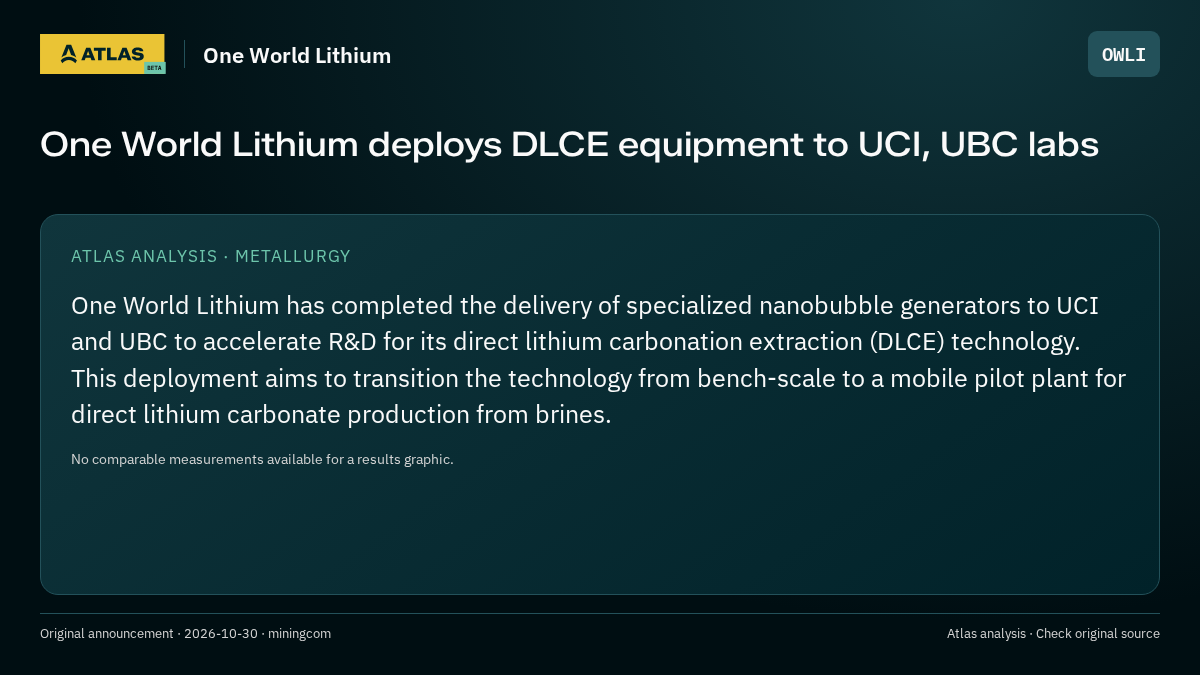
One World Lithium has completed the delivery of specialized nanobubble generators to UCI and UBC to accelerate R&D for its direct lithium carbonation extraction (DLCE) technology. This deployment aims to transition the technology from bench-scale to a mobile pilot plant for direct lithium carbonate production from brines.
Reasoning: The company is advancing its proprietary DLCE technology through academic partnerships and equipment deployment, moving toward pilot-scale validation.
Positive factors
- Transition from bench-scale to pilot plant scale
- Deployment of specialized equipment to academic labs
- Potential for single-step direct lithium carbonate production
- Acid-free extraction method reduces environmental/cost intensity
Negative factors
- Technology is still in R&D/pilot phase
- Field-test pilot plant not scheduled to begin until early 2027
Facts used in scoring: 2
Classification and evidence
Mill Routeneutral
Processing via mill or concentrator (CIL, CIP, tank leach, flotation).
Why it applies: The technology involves a specialized extraction process (DLCE) using nanobubbles in a lab/pilot setting.
Evidence · text
“transitions OWL’s proven bench-scale success into a mobile, containerized pilot plant”
Multi-Domain Testedpositive
Variability across ore domains (oxide, transition, fresh) has been addressed.
Why it applies: 2 distinct composites were tested
Extracted facts
Stored fact records: 2. Some facts used in scoring do not have a stored record.
Metallurgical Results (2)
direct lithium carbonation extraction (DLCE)One World Lithium DLCE Project · lithiumView all detailsHide details
Identity
- Project
- One World Lithium DLCE Project
- Commodity
- lithium
- Ticker
- OWLI
Test Work
- Program Status
- preliminary
- Test Type
- direct lithium carbonation extraction (DLCE)
- Processing Route
- carbon dioxide (CO2) nanobubble extraction
- Sample
- natural brines via DLCE technology
Lab
- Laboratory
- University of California, Irvine (UCI) and University of British Columbia (UBC)
- Consultant
- Moleaer
Review
- Needs Review
- No
- Historical
- No
Dates
- Event date
- 2026-10-30T00:00:00.000Z
Reasoning: Novel extraction method being validated in academic settings.
Positive factors
- Single-step production potential
- Eliminates traditional concentration steps
Negative factors
- Still in R&D phase
Evidence · text
“accelerate the R&D work on the company’s single-step direct lithium carbonation extraction (DCLE) technology”
DLCE technology test workOne World Lithium DLCE Project · lithiumView all detailsHide details
Identity
- Project
- One World Lithium DLCE Project
- Commodity
- lithium
- Ticker
- OWLI
Test Work
- Program Status
- preliminary
- Test Type
- DLCE technology test work
- Processing Route
- acid-free lithium slurry formulation
- Sample
- lithium bearing clay
Lab
- Laboratory
- UCI and UBC labs
Review
- Needs Review
- No
- Historical
- No
Dates
- Event date
- 2026-10-30T00:00:00.000Z
Reasoning: Testing ability to produce lithium carbonate from clay without traditional reagents.
Positive factors
- Acid-free process avoids sulfuric acids and soda ash
Evidence · text
“laboratory teams will conduct test work on lithium bearing clay to formulate an effective lithium slurry”
How Atlas produces this analysis
Minestarters Atlas uses automated extraction to summarize mining announcements, identify reported measurements, and classify supporting evidence. Sentiment reflects the extracted narrative and classification rules; it is an interpretation, not a reported measurement. Evidence quotes and context are provided where available. Missing data, low-confidence results, and review flags indicate limitations. Check the original publisher announcement before relying on an interpretation.