
Aurwest Resources Announces Filing of NI 43-101 Technical Report on the Porter Lake Uranium Property, Northern Saskatchewan
Original announcement by thenewswire on
- Company
- Aurwest Resources Corporation
- Ticker
- AWR
- Exchange
- Unavailable
- Region
- Northern Saskatchewan
- Primary commodity
- Uranium
- Secondary commodities
- Rare earth elements
- Document categories
- Other, Drill results
- Extracted
- 2026-11-03 12:33:00 UTC
Analysis by Minestarters Atlas
Atlas analysis published:
Minestarters Atlas analysis
Summary
Aurwest Resources has filed an NI 43-101 technical report for its Porter Lake uranium property in northern Saskatchewan. The report identifies three uranium target areas supported by historical high-grade samples and 2025 airborne radiometrics, and recommends a two-phase exploration program totaling approximately $2.1 million.
Reasoning: The document announces the filing of a technical report which formalizes the exploration strategy and validates historical targets, though it contains no new assay results or resource estimates.
Positive factors
- Filing of a formal NI 43-101 technical report provides a structured baseline for the property
- Identifies three distinct uranium target areas
- 2025 airborne radiometrics support historical high-grade showings
- Clear two-phase exploration program recommended with specific budget
Negative factors
- No mineral resource or mineral reserve estimate contained in the report
- Historical data lacks modern QA/QC and has not been verified
- Property is at an early stage of exploration with no modern drilling completed
Facts used in scoring: 4
Classification and evidence
No QA/QC Disclosurenegative · Story-specific tag
Release does not disclose QA/QC — lab certification, CP/QP sign-off and assay protocols cannot be checked from this document.
Why it applies: The technical report relies on historical grab and trench samples and drilling that were collected without modern QA/QC and have not been verified.
Evidence · text
“They come from selective grab and trench samples and historical drilling, were collected without modern quality assurance and quality control, and have not been verified”
Extracted facts
Stored fact records: 1. Some facts used in scoring do not have a stored record.
Drill Results (1)
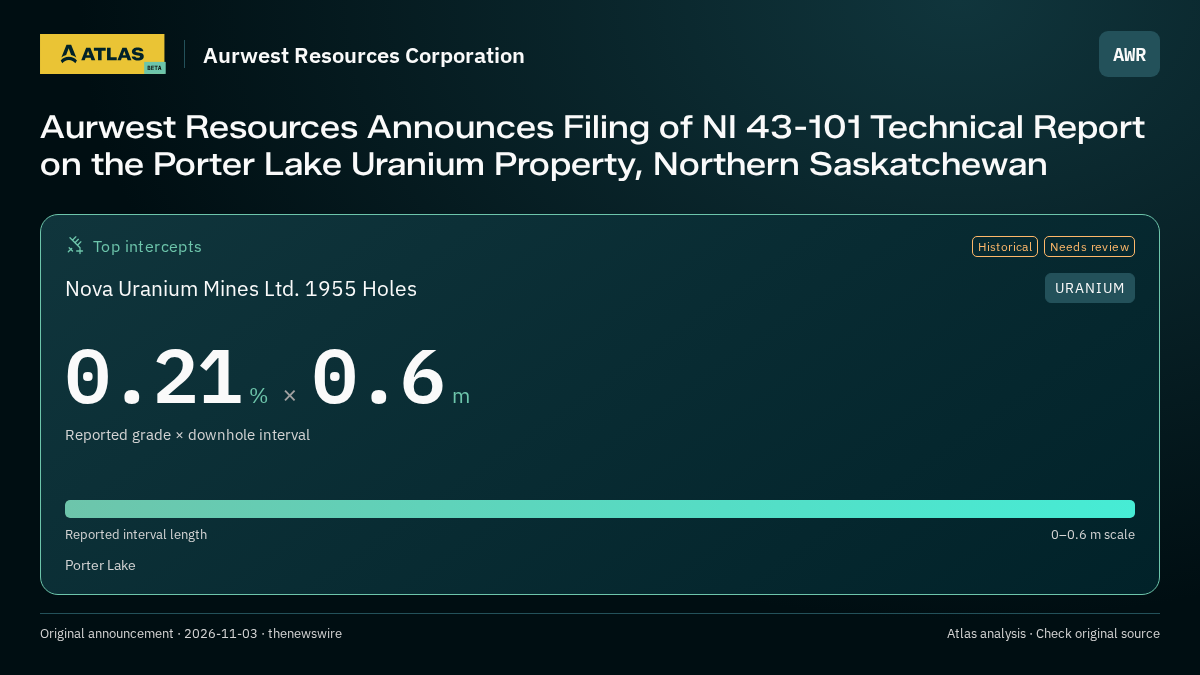
Nova Uranium Mines Ltd. 1955 holesPorter Lake · uraniumGrade: 0.21Grade Unit: %Intercept: 0.6 mHistorical resultNeeds review: ungroundedView all detailsHide details
Identity
- Hole ID
- Nova Uranium Mines Ltd. 1955 holes
- Project
- Porter Lake
- Commodity
- uranium
- Region
- canada_sk
- Reported Region
- canada_sk
- Ticker
- AWR
Geometry
- Grade
- 0.21
- Grade Unit
- %
- Intercept
- 0.6 m
Classification
- Sample Type
- drill
Location
- Location
- Blackstone Lake
- Loc. Source
- document
QA/QC
- QA/QC Disclosed
- Yes
- QP Signed
- Yes
- QA/QC Methods
- standards
Review
- Needs Review
- Yes
- Review Reason
- ungrounded
- Interp. Status
- low_confidence
- Historical
- Yes
- Historical Source Date
- 1955-01-01T00:00:00.000Z
Dates
- Event date
- 2026-11-03T00:00:00.000Z
Reasoning: Historical drilling at Blackstone Lake in 1955 reported 0.21% U3O8 over 0.6m.
Positive factors
- Identifies narrow high-grade interval in historical drilling
Negative factors
- Extremely narrow interval (0.6m)
- Historical data without modern QA/QC
Evidence · text
“In 1955, Nova Uranium Mines Ltd. drilled six holes (324 m) and reported narrow intervals of up to 0.21% U₃O₈ over 0.6 m”
Tags used in scoring
QA/QC Disclosedpositive
Release includes QA/QC disclosure — certified lab, QP sign-off, or stated methods (blanks, standards, duplicates).
Why it applies: qaqc_disclosed is true
Cut-off Undisclosednegative
High-grade interval reported without stating the cut-off grade used for compositing.
Why it applies: no cutoff_grade was stated
Stale Data Re-releasenegative
Historical results re-announced with no new assays or reinterpretation — low genuine novelty.
Why it applies: the fact restates a prior release
How Atlas produces this analysis
Minestarters Atlas uses automated extraction to summarize mining announcements, identify reported measurements, and classify supporting evidence. Sentiment reflects the extracted narrative and classification rules; it is an interpretation, not a reported measurement. Evidence quotes and context are provided where available. Missing data, low-confidence results, and review flags indicate limitations. Check the original publisher announcement before relying on an interpretation.